
The world is militarising, and conscription is back. What happens to those who believe that violence is not the answer?
To find out, I spoke to Yurii Sheliazhenko, Executive Secretary of the Ukrainian Pacifist Movement, legal scholar, and winner of the Seán MacBride Peace Prize.
Yurii has been a declared conscientious objector since 1998. He’s also been charged with justifying Russian aggression — based on a document he wrote that explicitly condemns Russia’s invasion of Ukraine. His trial will be on May 13.
I had a fascinating discussion with Yurii, and learned a lot. Scroll down for an edited transcript of the interview, the video itself (or audio podcast here if you prefer). And after, the usual five links + quick thoughts you’ll find in each edition of this newsletter
First, here are my quick take-aways from this interview and from preparing for it:
- The machinery of forced conscription is breaking down. In Ukraine, 200,000 soldiers have gone AWOL, 2 million men are dodging draft notices, and hundreds of thousands of Ukrainian males abroad are refusing to return. The Ukrainian state can’t compel its citizens to fight at scale, and it’s responding with violence rather than persuasion. This isn’t a sign of strength, but the opposite: it’s systemic failure.
- The system that sends people to die is corrupt at every level. Officials sell medical exemptions for thousands of dollars while ordinary men are grabbed off the street and sent to the front. This is a feature of forced conscription everywhere.
- The distinction between draft evasion and conscientious objection matters. Millions are refusing to fight, but most are doing it individually, in silence, without a framework. Yurii was clear: evasion is individual, but conscientious objection is organised, principled, and aimed at abolishing the institution itself. One hides, the other confronts. That’s an important difference, and one I hadn’t properly understood before.
- His refusal to dehumanise his tormentors while they were beating him was striking. This was the hardest moment to listen to. The Ukrainian authorities beat him, put pepper spray into his eyes, dragged him by his hair.... and his response was to treat them as human beings. Because he believes that’s how you break the cycle of violence. That discipline under pressure is something every activist can learn from.
- This is coming to the rest of Europe. Nine EU countries have conscription today. Germany is screening 18-year-olds. France is launching military service this summer. NATO members have committed to spending 5% of GDP on defence. The US has opened a new war with Iran and missiles have already hit NATO territory. Yurii’s story is a preview of what’s coming.
- Nonviolent resistance works — but only if people know how to do it. Yurii’s sharpest point: millions of Ukrainians disagreed with forced conscription, and it made no difference, because disagreement without organisation and technique is just noise. The resources exist — handbooks, case studies, organisations (I have listed them below). It’s just that people don't know about them.
Video and transcript
YURII: I am a citizen of Ukraine and a citizen of the world, seeking a very simple thing — peace in my country and everywhere else. Abolition of war. I’m not asking too much from humanity — just that every human being lives in dignity, and isn’t forced to participate in mass killing.
This is a longstanding view. When I was very young, my father tried to teach me how to fight. And I asked him: why do I need to beat someone else if they feel pain?
MEHRAN: Let’s set the scene. It’s February 2022, Russia’s full-scale invasion of Ukraine has begun. You’re an academic, in your forties. What was being asked of you — and of Ukrainian men generally — at that point?
YURII: Our government is totally subservient to the army. And the army thinks that everyone, especially every man aged 18 to 60, should fight. And of course it is very cruel to people who for some reasons cannot fight — who are sick, who have serious family circumstances. And of course to conscientious objectors, who for religious or philosophical or political reasons refuse to participate in mass killing. Because people like me understand that any mass killing is very wrong — not only to the so-called enemy, but also to your own people.
MEHRAN: How long is mandatory military service now in Ukraine?
YURII: Currently it is indefinite. To the end of the war. But according to the official discourse, there will be no end to the war… because Russia is not going to stop.
MEHRAN: Tell me about when you were called up to fight.
YURII: The draft call was sent in December. I was asked to appear in the conscription office on Christmas Eve, at 9am — which is the minute of silence for remembrance of victims of Russian aggression. I am a known conscientious objector. Of course, it was an open threat.
So I immediately informed many friends and colleagues. There was a joint press release of more than a hundred organisations from more than thirty countries — religious organisations, civil society organisations, peace networks — saying that mandatory military registration of conscientious objectors is a violation of human rights.
 sean
sean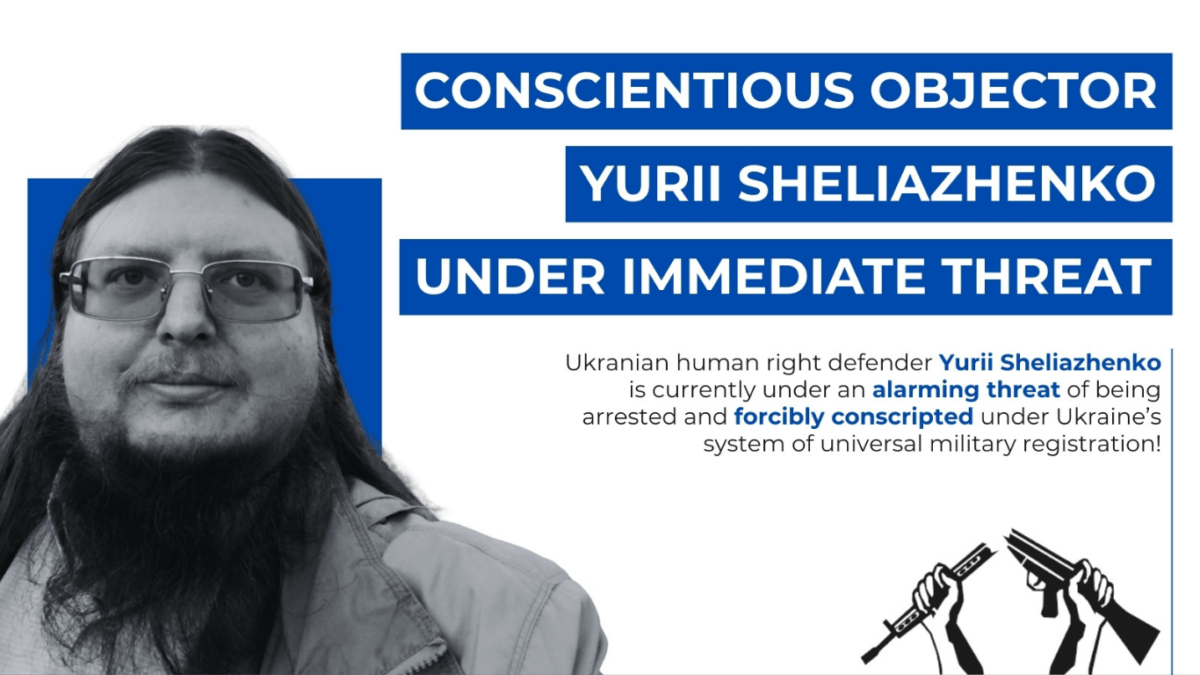
The Ukrainian Parliamentary Commissioner for Human Rights personally refused to take any steps to ensure the right to conscientious objection in wartime. Even when the European Commission demanded it — as a condition of Ukrainian membership in the EU. It was a disaster.
How power reacted: Yurii’s torture
MEHRAN: Let’s continue your story. What happened then?
YURII: What happened then is what I had warned about, and what the joint press release warned about. One evening, in a dark street, when I went to the post office to take my mail, I was forcibly taken and stuffed into a car. There were two police officers and some mysterious person — maybe from military recruiters, maybe from the security service, I don’t know.
They took me to a conscription centre. A soldier started to beat me. I fell on the floor. He seized my smartphone. And dragged me by the feet to a small room. And he sprayed pepper spray into this room. When I tried to get out, someone pepper-sprayed into my face.
It was horrible. Two days of arbitrary detention, beating, torture.
I was even threatened with an electric shocker. “If you don't shut up and stop demanding your release, we will electric shock you.” And there was an actual device, and I saw a blue flash.
I was beaten more, and several hours after spraying pepper spray into my eyes, I was taken to a medical commission. A place to determine fitness for military service. I couldn’t even open my eyes.
Once there I demanded: please help me, I need medical treatment.
They said to me: “There are no doctors. There is a medical commission only. People are not treated here, only examined [for service].”
MEHRAN: So they’ve sprayed you with pepper spray — a chemical weapon — beaten you, and then refused you any medical treatment.
YURII: When I insisted on some medical treatment to heal my eyes, they ordered me to go back to the recruitment centre. I refused. I said there should be some doctors here. Please give me medical treatment or release me.
They beat me and pushed me on the floor. And one soldier dragged me by my hair. It was such pain. And when I screamed, he changed and dragged me by my feet to the minibus to go back to the recruitment centre.
It was hell.
It was a miracle that in the end I was allowed to leave. I was probably released because at that time, on March 21 [2026], there were a lot of people internationally making complaints and asking about me. I am so grateful to friends in Ukraine and internationally for this big solidarity campaign.
MEHRAN: How did you feel towards your tormentors at that time? What was going through your mind?
YURII: I was outraged by the injustice. I appealed all the time to my rights under the Constitution of Ukraine. The response was usually obscene, offensive words.
One nurse, denying me medical healing, said to me, in Russian: “stuff your Constitution of Ukraine into your back.”
I tried to communicate with my tormentors as human beings. I didn’t consider them enemies. There is something good in every person.
MEHRAN: A nurse said this to you.
YURII: Yes. Instead of helping me to at least cure my eyes. And it was one of the most polite things I heard during these two days.
But also, they were wondering why, unlike the other people detained, I was not swearing back at them. Because I believe that every human being has conscience, every human being has dignity, even if a human being is behaving barbarically. There is something good in every person. And I tried to communicate with my tormentors as human beings. I didn’t consider them enemies.
Maybe that also helped. Because after arbitrary detention, many people have been beaten more severely than me. And some have been killed in detention.
The broader picture — millions refusing
MEHRAN: As someone who refuses to fight, you’re not the exception here. Hundreds of thousands have gone absent without leave. Millions have left Ukraine to avoid this. So this is something shared by many, many people, who simply do not want to be fighting.
YURII: You’re right. And the tragedy is that these people are disorganised.
People who avoid the draft — it’s not hundreds of thousands. Hundreds of thousands are people who were forcibly conscripted and then left military units without permission. But think about people who didn’t even comply with mandatory military registration. [Ukrainian Defence] Minister Fedorov says two million. Actually it is more people — it’s a downplayed number.
Add to this many Ukrainian refugees in European countries — a million males. Only in Germany, there are 350,000 Ukrainian males of conscription age. And these people are not returning to Ukraine, despite our government trying hard to force Ukrainian males abroad to return — by denying or delaying their passports, by pushing for European governments to stop giving collective humanitarian protection to Ukrainian males.
By the way, some governments in Europe are starting to give in to this pressure. For example in Norway, they’re now considering not to give humanitarian protection to Ukrainian males.
MEHRAN: Just for context — Ukraine has a population of 38 million, and the 18-to-60 cohort would be roughly 23 to 24 million.
Draft evasion vs conscientious objection
MEHRAN: OK. What’s the difference between evading the draft and conscientiously objecting?
YURII: People who avoid the draft just refuse to take seriously their responsibility before their people, before their country — to protect their country. They’re saying: I don’t want it. ‘I fear dying. This state hasn’t helped me, so I have no duties.’
Conscientious objection is a religious or other belief — philosophical, political, scientific — which is contrary to any military service, any participation or support of war.
There’s a formula adopted by War Resisters International, that says:
War is a crime against humanity. Therefore I am determined not to support any kind of war, and to strive for the removal of all causes of war.
Conscientious objection includes the desire and determination to work for the abolition of war. It is a hope for a better world where everyone will refuse to kill, and therefore there will be no war. It links personal rights — the right to refuse to kill — with the vision of common good: a world without war.
On stopping the war
I am ready to die to defend my right not to kill.
MEHRAN: I know there may be people watching who say: you were living in a country that was invaded. Russia is the aggressor. People are dying to defend your right to refuse. Refusing isn’t going to get Putin out of your country. What’s your solution?
YURII: People are ready to die to defend their rights. Actually, I am also ready to die to defend my right not to kill others.
If everyone were prepared to live free from military suppression, it would be impossible for militaries to enslave them into their armies. Furthermore, they did not manage to enslave one person, in my case. When you are determined, when you know some basics of nonviolence, you could survive even very violent attempts to make you part of a system of industrialised mass killing.
When we discuss stopping Russian aggression, it must include diplomacy, peace talks. And not only diplomacy at the level of leaders. Leaders could negotiate and agree on very unfair peace. Specialists like Trump and Putin could meet and decide the fate of Ukraine without Ukraine.
Civil society must also be represented at any peace negotiations. And there should be solidarity — for example, between pro-peace Ukrainians and pro-peace Russians.
I am trying to do my best to support those Russians who are refusing to kill Ukrainians. And also the Israeli conscientious objectors — from Mesarvot and other organisations — who are refusing to participate in genocide just because the government says they’re enemies.
There will be no peace without justice. And justice starts with recognition of the dignity of any person.
The wider conscientious objection movement
MEHRAN: How big is the organised conscientious objector movement in Ukraine?
YURII: Unfortunately, not very big and not very organised. It is hard to be a pacifist when every day your country is suffering from explosions of ballistic missiles. Russian drones are killing people and destroying cities, destroying homes. One peace researcher who lives several kilometres from here — a Russian drone exploded and burned his library. Fortunately he was in a shelter at that time.
So pacifists are suffering like all people in the country. But despite all this pain, we need to remember that the principle of nonviolence is universal.
MEHRAN: Is there contact between conscientious objectors across the warring countries — Ukraine and Russia, Israel, anywhere else?
YURII: Yes. There are a lot of peace organisations. For example, the International Peace Bureau, which is more diplomatically oriented — it traditionally helps to unite parliamentarians who work for peace. War Resisters International is a network of conscientious objector organisations worldwide. And the European Bureau for Conscientious Objection is the European umbrella network.
And there is indeed currently a big push in Europe for conscription, which is a problem.
MEHRAN: That’s right. Nine EU countries have compulsory service. Germany introduced a new military service law a few months ago. France is launching military service this summer. NATO members just committed to spending 5% of GDP on defence. We’ve got live wars, NATO territory being attacked.
So what would you say to someone watching this — maybe a young person in Germany or France or Portugal — who’s thinking: this could be me next?
The military manages to use the illiteracy of people in matters of peace, to falsely convince people that you need to go to war to achieve peace.
YURII: I would say first, be prepared and start to learn nonviolent techniques. It’s not enough just to disagree with the proliferation of militarism. Millions of Ukrainians disagreed with violent conscription. And yet it continues.
The military manages to use the illiteracy of people in matters of peace, to falsely convince people that you need to go to war to achieve peace. That facing violence, the only response is to be violent or surrender.
It is not. There is always an option of nonviolent resistance. But people don’t know it. And this is exactly what people need to learn.
It is not enough to protest, not enough to demand something from your government. It is great that in Germany, when the new policy of draft registration was adopted, hundreds of thousands of young people came out to demonstrate. But people also need to learn how to resist violence without violence, and how to organise.
Nonviolent resistance in practice
MEHRAN: Are there examples where people have successfully resisted through nonviolent means?
YURII: Yes. For example, the unarmed community of the Ukrainian town of Koryukivka — when Russian tanks came to their city, the people without any weapons stood in protest on the way of the tanks. And the tanks stopped, and after a while went away.
It was an amazing result, where Russian armed forces were repelled by the power of the people.
Of course, any exact tactic which is applicable in one particular place at one particular time may not always be applicable. But the whole body of peaceful approaches can always be creatively used in any circumstances.
MEHRAN: Are there resources where people can access these — case studies, handbooks, that kind of thing?
YURII: Yes. War Resisters International has a handbook on nonviolent campaigns. World Beyond War has a book called “Alternative Global Security System” — a compendium of knowledge about war abolition. And there is a famous book by Chenoweth and Stephan, “Why Civil Resistance Works,” which has also been translated into Ukrainian.
If you want to learn nonviolent methods, you will always find sources. But it starts from the choice to work for peace, not for war. It starts from recognition that any people in the world are not deserving of industrialised mass killing.
Close
MEHRAN: Is there anything else you would like to add as we close?
YURII: Conscientious objection is a hope for a world without war. Those who are called to prepare for war need to think about not participating in war, and to prepare for peace.
Think big. Because it is not enough to refuse to take part in the evil of war. You need to change the world for good. To create peaceful institutions — agencies for nonviolent resistance, institutions of social solidarity, institutions of peace education, institutions of dialogue and art.
MEHRAN: Yurii, thank you very much for your time. It was a very inspiring conversation. All my best to you. Stay safe, and all the best in your struggle.
YURII: Thank you, Mehran. It was a pleasure to have this conversation.
Five things worth reading
- Micah Sifry crunches the numbers on the No Kings 3 protest — and the picture is more complicated than the headlines. Millions marched, yes. But the movement is still skewing older and educated, and the youth gap isn’t closing. He notes: “A twenty-something walking into a room of grey hairs may be welcomed, but they’re also going to wonder why they should invest time with a bunch of people twice or three times their age.” Another important observation: never underestimate the role dating opportunities play in movement scenes. I agree.
- Grace Blakeley on how a group of elderly tenants in Leigh-on-Sea — paying over £2,000 a month collectively in service charges while bins overflowed, stairwells went uncleaned, and a broken lift trapped a 96-year-old — organised through ACORN and forced their landlord to act. Official channels failed for months; collective – organised! – action worked in weeks. The mechanics are worth studying. (Grace was also on the show recently talking Iran.)
- Dominic Packer and Jay Van Bavel on the psychology of climate messaging, and why doom backfires. Their research shows fear alone doesn’t mobilise people, it paralyses them. What works is framing around agency (showing people quick wins) and collective efficacy. Worth reading well beyond climate: the same logic applies to any campaign, where the left has been talking loudly and losing.
- Two reads on where the platform landscape is heading. Ryan Broderick on what happens when the short-form video bubble pops. The ad model is wobbling and the creator economy is more fragile than it looks. (FWIW, I think the next big thing could be video with the distribution and intimacy properties of email.)
- And James Ball asks whether Bluesky is dying: daily engagement is down, the growth has stalled, and the left’s favourite Twitter replacement may not be the answer it looked like eighteen months ago. Both worth reading together if you’re thinking about where to put your attention online.
From the archive
Yurii’s sharpest point is one I’ve been making for years: millions opposed something, and it changed nothing, because mass without method isn’t power. This piece from 2022 is still the clearest thing I’ve written on why “do we have the numbers?” is usually the wrong question.
 Mehran Khalili
One more thing
Speaking to your base feels like solidarity. Growing your coalition requires translating your principles into terms other people already care about. The two are not the same – and confusing them is how movements stay small.