
I wouldn’t normally be sitting in the cramped first-floor office of a camera shop in Athens city centre on a Saturday morning, but there we were, 10 of us, wannabe Leica shooters and the merchandise on the desk, laid out like weapons in an illicit handover. “If we knock this down, there goes €100,000,” said someone, and they were probably right. But the fact that they expressed it at all, and with a nervous laugh, told you everything about the room.
This is Leica. The pinnacle of camera equipment, Cartier-Bresson’s tool of choice, and price tags to match. Most of my favourite photographers shot their best work on Leicas.
But I also know that Leica is owned by private equity, uses parts from not-so-elite manufacturers like Panasonic, and the people who tend to own their equipment take, well, terrible photos of their young girlfriends at champagne receptions. The images are sharp, beautifully rendered, and dull as fuck.
Reviewers fawn over the Leica ‘look’, that little something that other camera brands can’t match. I’ve got a decent eye, and I can’t see it. But then, I’m not part of the Leica club. And yes, even though much of my brain knows what the deal really is with Leica, even though I’ve spent fifteen years advising political campaigns on why people believe what they believe, I still wanted to be in it.
The Leica mystique, or perhaps I should say mythology, permeated the room that morning. We were there to try the cameras. Not just to see them, or hold them, but to go out shooting with them as if we owned them. I’d booked my slot three weeks ago, and had been counting down the days.
Reality, of course, had rudely intruded on my plans. The Leica shop had emailed me a few days ago with news that there would be ‘disruptions’ to our testing event. Metro stations across Athens centre would be closed for a protest for the anniversary of the Tempi train disaster, where 57 people died and the government has spent three years covering up why. The city centre would shut down, and there could be violence. The shop had considered cancelling the event, but decided to push on.
But that wasn’t the worst. And as I checked the headlines over coffee before setting off to find an electric scooter to get to Leica, I saw that America and Israel had dropped the first bombs on Tehran, after weeks of bluster and threats. I have many family members there; this could be a pivotal day. I should probably scrap the Leica event and spend my time absorbing information, watching the first narratives take shape, trying to reach family on the frontline.
This was Leica, though, and it offered an escape. From the world falling apart, from kids, from my ageing parents, from commitments, from all of it. And the cameras on the table — and the creative, uncompromising lifestyle they promised — were exactly that.
The shop staff were overwhelmingly nice, as people are when large amounts of money might change hands. Coffee was free. We got little badges, like we were at a convention. They looked expensive.
Oliver, the chap who had come from Leica HQ in Wetzlar, Germany, introduced himself. He was surprisingly down-to-earth, dressed in trainers and jeans, like most of us here. I’d expected to find the sort of people in the review images, impeccably coiffed and suited.
We sat in a semicircle on plastic chairs. Oliver stood in front of the merchandise table. He asked us what we were into, what we were looking for from this event. He started with me. I didn’t hesitate.
I was there for the Leica Q3 Monochrom, which came out in November 2025 and had been my dream camera for years before it even existed. Not just because of the brand, but because its specifications read like they had been designed for me. I always shoot at 28mm, in black and white. The Monochrom only shoots at 28mm in black and white. I like night shots. The Monochrom, according to the reviews, can basically see in the dark.
The conditions were right, too. I’ve been shooting for nearly twenty years. I’ve had some exhibitions; I take my photography seriously. My camera, a Fuji I’d been using since 2017, was showing its age — even more so since the Monochrom came out. It still works. But it’s been repeatedly dropped, broken, repaired. It’s not in great shape. The time had come to take the next, weighty step.
So I’d become obsessed with the Monochrom, binging rumour sites and forum posts before it came out, then the announcement pages and early reviews, the manual which I’d downloaded and printed and devoured, the ‘tips and tricks’ shorts, the hours of unboxing videos, the comparisons I’d asked AI to generate, the ‘long term tests’. Most of it late into the night. They all said the same thing: “If you can afford it, go for it. You won’t be sorry.”
Yes, there’s the catch. I was hinting at it before, but I have to come out with it: the Monochrom costs €6750. My Fuji? Less than a quarter of that. I was here to see if, in a hypothetical scenario where I could afford to drop €6750 on a camera, I’d regret it.
I explained it to Oliver and the rest of the room, using those exact words. He smiled and nodded, even though I was mentioning the unmentionable: price.
Oliver went around the semicircle, asking each of my fellow camera-folk the same question. They seemed a good bunch, mostly hobbyists, and two professional photographers who I’d met before. Each came forward and declared their camera of choice, with the embarrassed candour of people admitting to something they know is excessive. It took too long but it didn’t matter, because the merch kept drawing eyes and grins.
And then it was done. Enough formalities. It was time to take our weapons. Oliver passed the Monochrom to me.
I’d handled it once before, in the same shop, when I first made the appointment. But it felt lighter now. I made a mental note — good. Lightness is important. A camera needs to be the extension of your arm, of your eye.
Then I took it into the toilet, discreetly so people didn’t think I was odd, closed the door, and tested how it handled the dark. It was impressive. Fast shutter shots, lit by just a sliver from beneath the door, looked punchy and clean on the camera screen.
A few blocks away, the Tempi protest started. Oliver looked uncomfortable, as tourists do whenever they hear a Greek voice through a megaphone leading a crowd on the streets. He had probably memorised the address of the German embassy. His hosts, the camera shop owners, were embarrassed. One of them approached me and apologised for the inconvenience, shrugging as if to say ‘this is Greece’, not knowing I live here, work in politics, and deplore the government’s cover-up. I said no, people must protest — 57 died and the government is hiding why. She nodded, and said nothing.
The group went outside and we took photos of each other awkwardly. The shouts and chants of the protest grew nearer, cutting through the streets emptied by the march. Oliver led us away, up the hill towards Exarchia. That’s the anarchist district. He had no idea.
I checked my phone as I walked; I had a video from my cousin, taken from his balcony in central Tehran. Thick plumes of smoke swirled from burning buildings just a few kilometres away. His voice struck me the most: “What the FUCK?” As I stared at the screen, my mother called; credit card is blocked, will you ask the bank to fix it. I can’t Mum, I’m… at a meeting. Use another card for now. I dove back into Leica, disappearing behind the Monochrom’s viewfinder and shooting anything I could find.
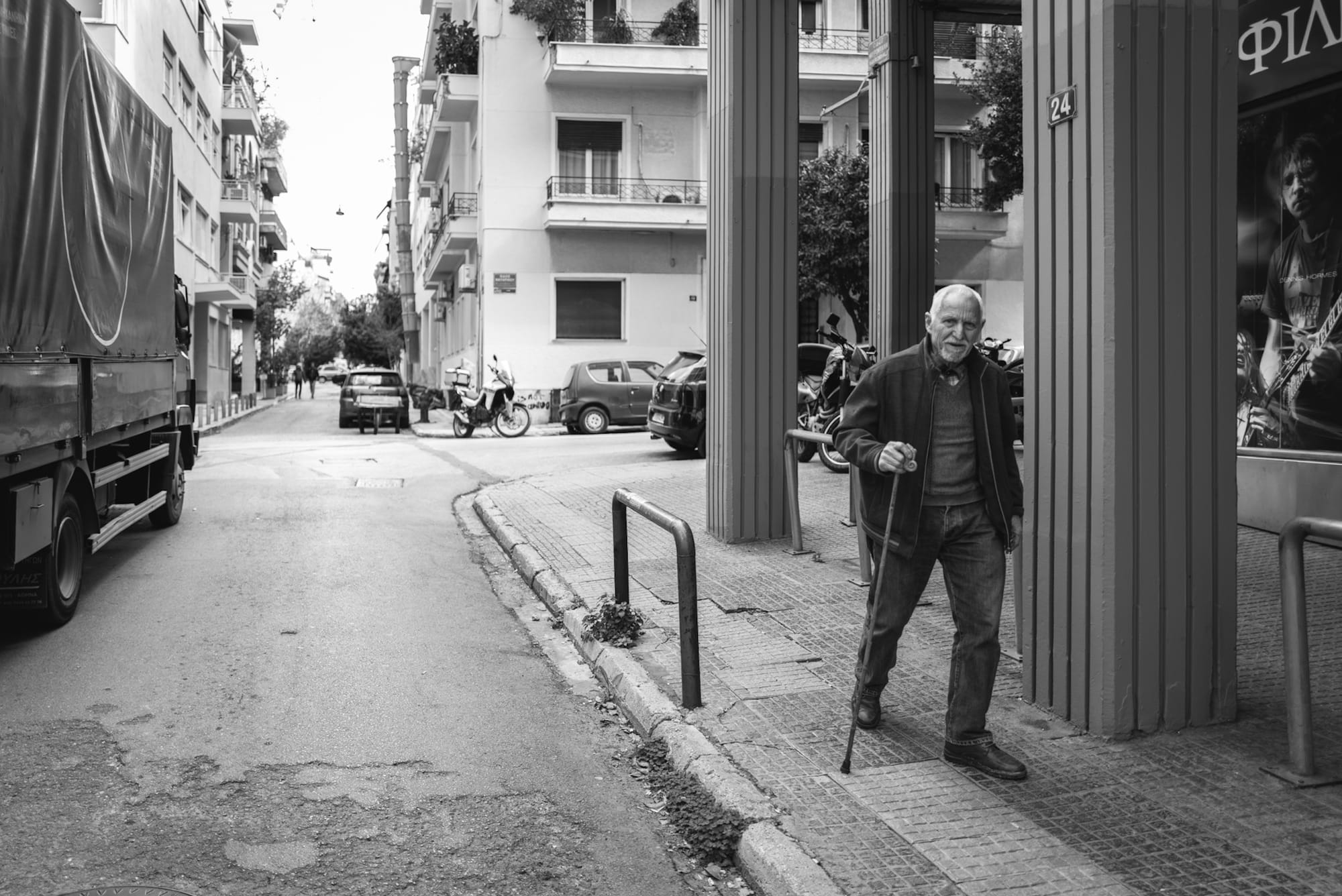
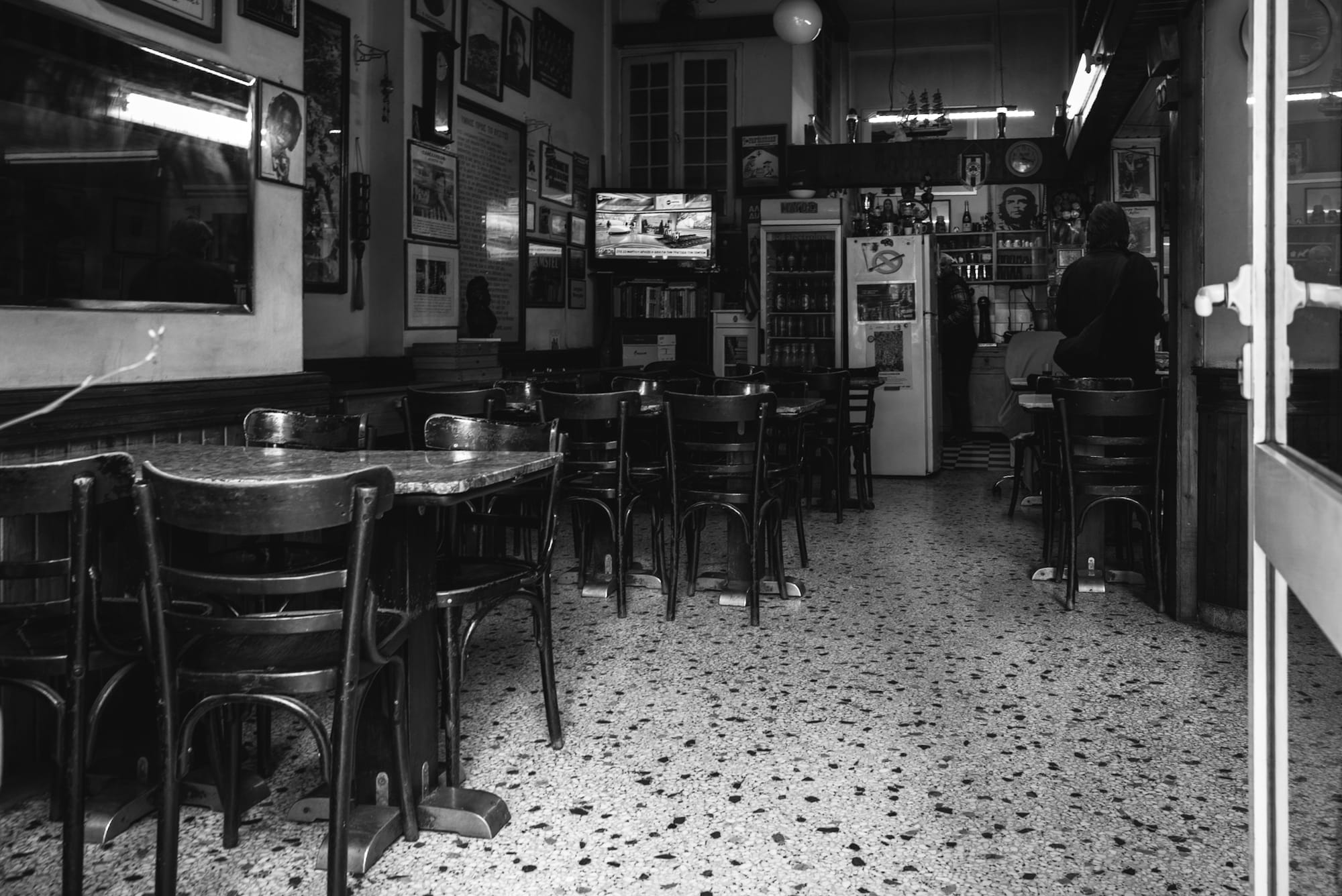
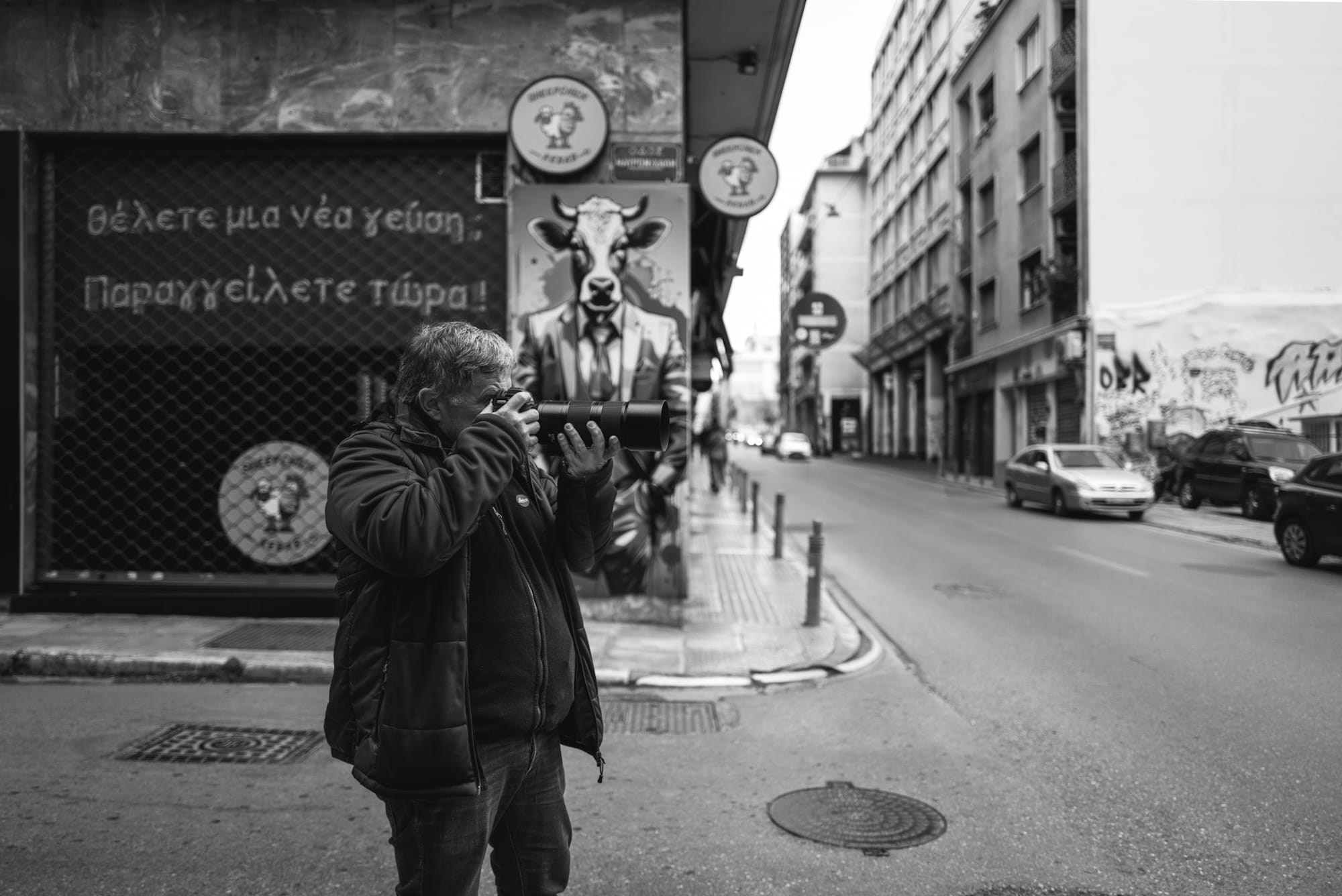
Athens, Greece, taken with the Monochrom (February 28, 2026)
* * *
After an hour with the Monochrom, the spell broke. Not all at once — more like a sequence of small disappointments that added up. The viewfinder was less immersive than I’d expected. The aperture ring got knocked out of its setting whenever I shifted my grip. Changing ISO required a two-step fiddle with a dinky dial. Autofocus hunted; manual focus was clumsy.
But the dealbreaker came outside, in the Athens light. Expose a scene correctly and the brightest parts — windows, clouds, the sunlit face of a building — were captured as pure white, the detail lost forever, like a phone camera from 2003. You can compensate by underexposing, but then you’re fighting the camera rather than using it. My Fuji doesn’t have this problem.
The Monochrom is a better camera than my Fuji. But it’s not four times better. It’s not even twice as good.
I returned to the shop and placed the Monochrom back on the desk. I asked Oliver for his business card, mainly out of guilt, and walked out lighter. The protest had now filled the city centre; many blocks around Syntagma square were densely packed with people. I stayed, checking my phone for news on Iran, texting relatives, sorting my mother’s issues with the bank.
Once home, I took out my Fuji camera with its grimy dials and scratched screen and battered lens hood, and felt grateful. It’s far from perfect, this thing. But it fits me, it works, and it will do.
* * *
In the weeks since that Saturday, I haven’t thought about the Monochrom once. Writing its name here feels strange, disconnected. I can barely remember why I cared.
But I do know, now, from the inside, what motivated reasoning feels like when it’s happening. The late-night YouTube sessions, the printed manual, the “if you can afford it” consensus. None of it felt like manipulation — it felt like research. Like I was being careful. I do this for a living, and I watched it happen to me anyway, right up until Oliver put the camera in my hands.
That’s what mythology does. It doesn’t need to deceive you. It just needs you to want it to be true.
Five things worth reading
- Vincent Bevins has a sharp piece on the leaderless student movement that’s been shutting down Serbia for 16 months — and is now preparing to enter electoral politics (see also my interviews with a Serbian student organiser here, and a movement leader here.)
- Iason Athanasiadis lived and studied in Tehran; he writes on why the US and Israel so badly miscalculated in this war — and why Iran isn’t folding.
- Nate Silver’s Iran War approval tracker is a must-check. As of writing, 54% oppose, up 6 points since March began. This is what organisers need to tap into.
- Noah Smith breaks down the economic impact of the Iran War. The US gets off lightly; Asia is being hammered.
- Lastly, Craig Mod has a thoughtful essay on consciousness, AI, and what meditation might tell us about what machines are missing. Worth the time.
From the archive
I wrote this about Ukraine in 2022, but the logic applies now. The images coming out of Iran are real – watching more of them isn’t a strategy.
 Mehran Khalili
One more thing
The smarter the person, the better they are at constructing a case for what they already believe. Which is exactly why you shouldn’t outsource your thinking to them.