

Like many of you, I’ve spent the last week hyper-anxious, refreshing feeds, trying to stay level-headed. Except this time — unlike the many other wars started or supported by the US of A — I have family in the central firing zone. I’ve encountered images of explosions and chaos and tragedy that I can’t unsee, on streets I’ve walked. Some of it video sent by family, filmed from their balcony. It’s awful, it’s real, and it’s here.
A majority of Americans opposed the war in Iran before the US first attacked – nearly 6 in 10 Americans disapprove, according to CNN/SSRS polling. That’s never happened at this scale with a major US military operation. For context, the Iraq invasion in 2003 launched with 72% public support. Afghanistan in 2001 had 90%. In Europe, majorities in Spain, Germany, Italy, and the UK also oppose the strikes. The opposition is there, and it’s strong.
So why isn’t there more pushback? The first “day of action” during the war drew small numbers in most US cities. London managed 50,000, which is an OK figure. But compare that to the million who marched against Iraq in 2003. The raw material for opposition exists – but it’s not converting into pressure.
What could be blocking that conversion? Three things: narrative, organisation, and the conditions organisers are working in.
(The photographs in this piece are ones I took in Iran.)

Narrative
With Iran, the usual anti-war frame doesn’t stick. This is a messaging problem that movements haven’t solved.
Recall that Trump’s central justification for attacking Iran was the regime’s killing of thousands of its own protesters in January — a massacre Khamenei himself acknowledged, even as he blamed it on foreign agents. That gave this war a human-rights framing that was more immediate than Iraq in 2003.
Holding two ideas at once — that the regime is brutal, and this war is illegal and catastrophic — is a tension movements need to learn to communicate. It shouldn’t be hard, but right now it is. The frame that’s winning is, as ever, the simpler one: bad regime gets what it deserves. Until the anti-war side finds language that holds both truths without collapsing into either, the other side’s story wins by default.
Also, to Western audiences, Iran is not a sympathetic state. Much more than Iraq, the regime carries decades of baggage in Western public memory — the US hostage crisis, Salman Rushdie, and proxy wars. When London’s anti-war marchers get headlined as “pro-Iranian protesters”, you can see the trap in real time. Movements, especially those led by values-first thinking, are particularly vulnerable to this.
And unlike Gaza — where the Palestinian diaspora was unified against the military campaign — the Iranian diaspora is largely welcoming the strikes. Celebratory rallies drew hundreds of thousands in LA, Toronto, and Munich. That deprives the anti-war movement of a constituency that normally provides moral authority, and emotional urgency: people outside the country who know it, love it, and are personally invested in its future.
This is a structural problem. You can’t run a “hands off Iran” campaign when the community you’d expect to anchor it is waving American (and sometimes Israeli) flags.
Organisation
There is no infrastructure to turn opposition into action — on either side of the Atlantic.
In America, the anti-war grassroots that opposed Iraq never really regained its footing after Obama’s election. In Europe, the left lost ground electorally throughout the 2010s, and never rebuilt equivalent capacity in the street.
The Democratic Party — leaderless, without a narrative — offers no vehicle. Europe’s scattered left parties are in no shape to amplify what opposition does exist. Anti-war sentiment is real, but there’s no machinery to convert it into coordinated pressure.
And because Trump has sidelined international institutions, there’s no UN process to rally people around. Remember 2003: the fights over Security Council resolutions, weapons inspectors, the drama of institutional resistance? That gave organisers a focal point. With Iran, the US has short-circuited all of that.
This isn’t specific to Iran, by the way. Trump has ordered strikes on seven countries since returning to office — Yemen, Syria, Iraq, Nigeria, Venezuela, Somalia, Iran — and faced no serious domestic opposition for any of them. Venezuela drew scattered protests in a handful of US cities; Nigeria drew none at all. Neither generated sustained pressure or shifted the debate. Iran just makes the gap impossible to ignore.
Conditions
Several things are actively suppressing an activist response.
Much of the anti-war argument is framed in moral terms: international law, justice, solidarity. Those matter. But they don’t always translate into widespread mobilisation when the war feels distant from daily life. When wars start to affect people materially — through conscription, prices, jobs, cuts to public spending — opposition tends to move from opinion into pressure.
Without consequences at home that people can feel, most people don’t have skin in the game. That’s not a moral judgment, it’s a structural one. And organisers need to factor it in. Every other condition holding activism back, lands harder because of this.
Like the speed at which the war came about. Iraq was telegraphed for months. There was a vote in Congress, and months of media build-up, which meant time to organise. The Iran strikes landed on a Saturday morning.
Yes, US forces had been encircling Iran since January. But the fact that negotiations were happening made it look like leverage. This meant organisers were behind before they started.
Also, years of Gaza solidarity — marches, the largest student protest wave in a generation — produced a lot of energy and passion. But they didn’t shift policy. That reality has hit activists hard. “What good would it do?” is a feeling I keep hearing. When there’s no connection between effort and outcome, motivation can easily drain away.
I can’t discount the establishment repression of Gaza organising, either. The ongoing de-banking, cancellations, criminal charges, police violence, all of it. Indications suggest it has had a chilling effect — on campuses, in the media, and on the street. I’ve heard this from several organisers: people are scared to act. These authoritarian tactics work. I hate it, but I have to acknowledge it.
Another big factor is issue overload. Just look at 2026 alone: in the US, ICE raids and mass deportations, federal programme cuts including Medicaid; Gaza, Venezuela. Anti-war competes for the same finite pool of organisers. No sooner have you been outraged and figured out what to do, than the next outrage arrives. There’s no coming up for air.
And conflict has, scarily, become normalised. As mentioned, the US has struck seven countries in just over a year. There’s a numbness to US military intervention that didn’t exist even a decade ago.
So what can we do?
The real question to me isn’t why people aren’t in the streets. It’s what will it take to convert poll opposition into power? Here’s what I’m holding onto:
Spain. Unlike any Western government during Iraq, Spain has condemned the strikes as an “unjustified” and “dangerous” military intervention, refused to let the US use its military bases, and held firm when Trump threatened to cut all trade. That’s not rhetoric; it’s material resistance at the state level. The kind of concrete refusal that organisers can point to, build on, and demand from other governments.
Contrast that with the UK, where Starmer initially refused to allow the US to use two of its bases, then reversed himself within 48 hours, reframing it as “defensive.” That’s the default European pattern: concern, then compliance.
Spain is the exception. The question for organisers is how to make the exception the rule.
And there’s this: the material conditions argument cuts both ways. As the war drags on, its costs will land at home — oil prices are already climbing, and the US is spending an estimated billion dollars a day. It’s only a matter of time before that starts competing with domestic spending. When the war stops being abstract and starts showing up in people’s lives, everything can change. That’s when opinion starts converting into pressure.
* * *
It’s thin, I know. I have a lot of thinking to do and conversations to have. These are field notes, not a strategy. But I think naming the blockers clearly is where strategy starts.

Five things worth reading
- Micah White on building an activist operating system: The features aren’t compelling to me (yet), but the framing is exactly right. We need more people thinking like Micah about this kind of infrastructure for movements – not just the next campaign tool.
- Cory Doctorow on how RSS quietly sidesteps the ‘enshittified web’ — no ads, no popups, no algorithmic interference — and why its decline was a deliberate choice by platforms that needed you somewhere they could monetise you.
- Caroline Crampton uses RSS to keep track of 2,000 feeds. All organisers should be on this.
- Eskandar Sadeghi-Boroujerdi on the internal logic of Iran’s regime. Recorded before the war, but more clarifying now than most of what's been published since. His read: the main risk isn’t US-backed regime change succeeding — it's Iran collapsing into military dictatorship.
- Sam Kriss on the Iran war as empire in its manic phase. The most vivid political writing you’ll read this month. Subscribe.
From the archive
At the height of the Greek crisis there were 12 protests a day — all of them resulting in nothing. This piece is about why vanilla protest fails, and what “creative tension” actually looks like in practice.
 Mehran Khalili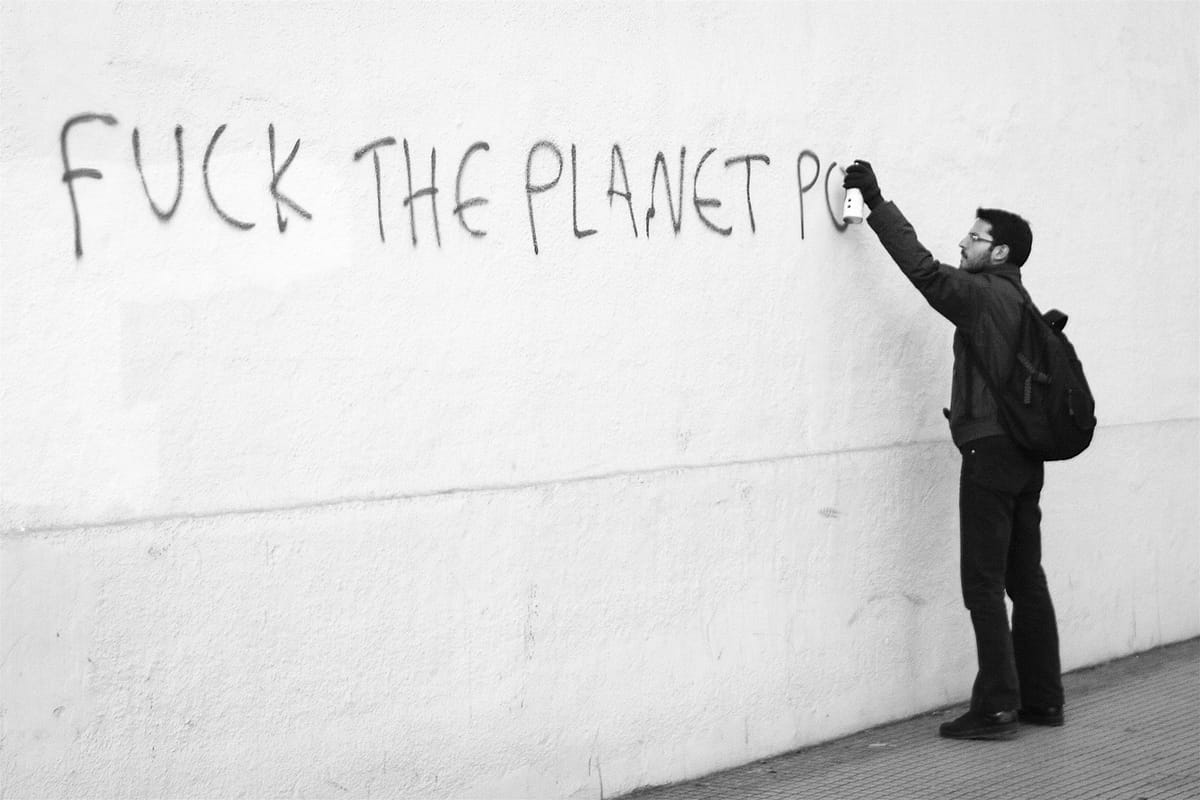
One more thing
Our opponents will paint any overreach as our strategy; they’ll frame any extremists among us as representative. The people who lose when that works aren’t the activists, but those we were supposed to be winning power for.


Tehran, Iran (June 13, 2005)